
 English
 русский
 Español
 عربى


Product Category
News Categories
Contact Us
Axial Fan vs Centrifugal Blower: Choosing the Right Air Mover for Your System
Content
- 1 The Short Answer: One Pushes, One Throws
- 2 Where Axial Fans Shine
- 3 Where a Centrifugal Blower Earns Its Keep
- 4 Axial Fan vs Centrifugal Blower: A Side-by-Side View
- 5 Matching the Type to the Job
- 6 The Drive Matters as Much as the Blade
- 7 A Five-Minute Selection Checklist
- 8 Mistakes We See Most Often
- 9 Final Thoughts
Almost every week an engineer sends us a drawing with a fan circled in red and one line underneath: axial or centrifugal? It is a fair question. Both are rated in airflow, both bolt into a panel or a duct, and both are called "fans" by nearly everyone who buys them, yet the two solve very different problems. Choose the wrong one and you spend the next few months chasing noise, vibration and a flow rate that never shows up on site.
What follows is the practical version of the conversation our application engineers have before anyone opens a catalogue: the geometry first, then the trade-offs, then the handful of numbers that usually settle the decision.
The Short Answer: One Pushes, One Throws
An axial fan moves air parallel to its own shaft. The blades cut through the air like a propeller, and the air leaves travelling in the same direction it entered, straight through the fan. Inlet and outlet sit in line, which is why axial units are slim, easy to mount on a panel wall, and often the cheapest way to shift a large volume of air.
A centrifugal blower works on a different principle. Air enters at the centre of the impeller, gets caught between the blades and is thrown outward by centrifugal force into a scroll housing. The scroll collects that fast-moving air and turns it roughly 90 degrees before discharge, converting velocity into static pressure along the way.
That single change in geometry explains almost every practical difference between the two: how much pressure each can build, how they sound, how much space they need and what they cost.
Where Axial Fans Shine
Axial fans are the workhorses of open, low-resistance airflow. Because the air path is straight and unobstructed, they are compact, inexpensive to manufacture and remarkably efficient when nothing is fighting them. In free air, an axial fan will usually beat a centrifugal blower of similar diameter on efficiency and on cost per cubic metre of air moved.
The trouble starts when resistance appears. Add a dense filter, a long duct run or a tightly finned coil and the pressure climbs, the airflow collapses and the noise rises quickly. Axial impellers are also more sensitive to uneven inlet conditions and to the way they are mounted, which is why a unit that performed beautifully on the bench can sound rough once it is screwed to a thin sheet-metal panel.
None of that makes them a poor choice. For condenser cooling, panel ventilation, electronics cabinets and general air circulation, a well-matched axial fan is hard to beat.
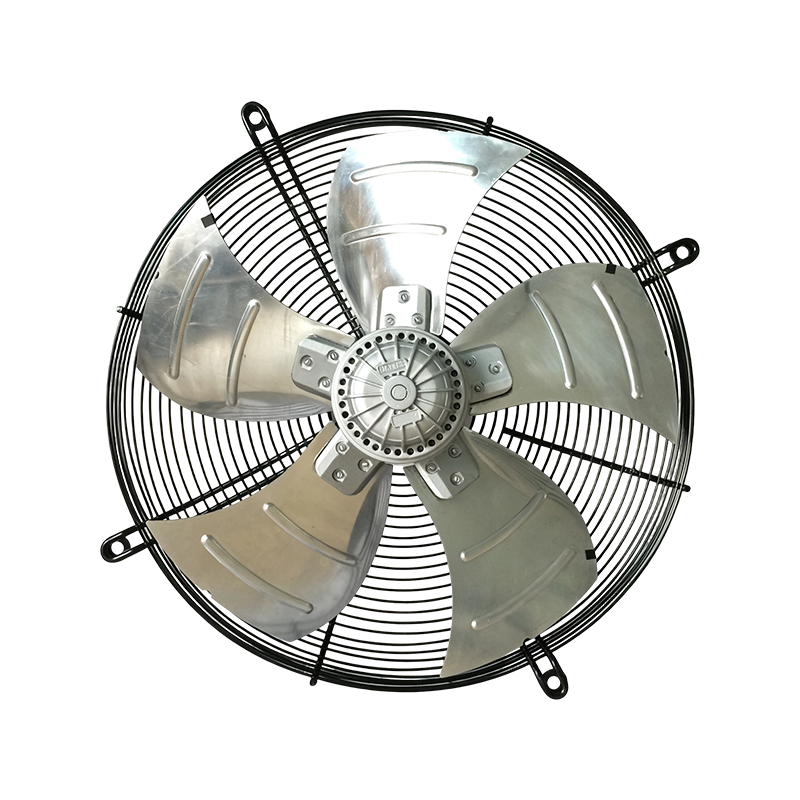
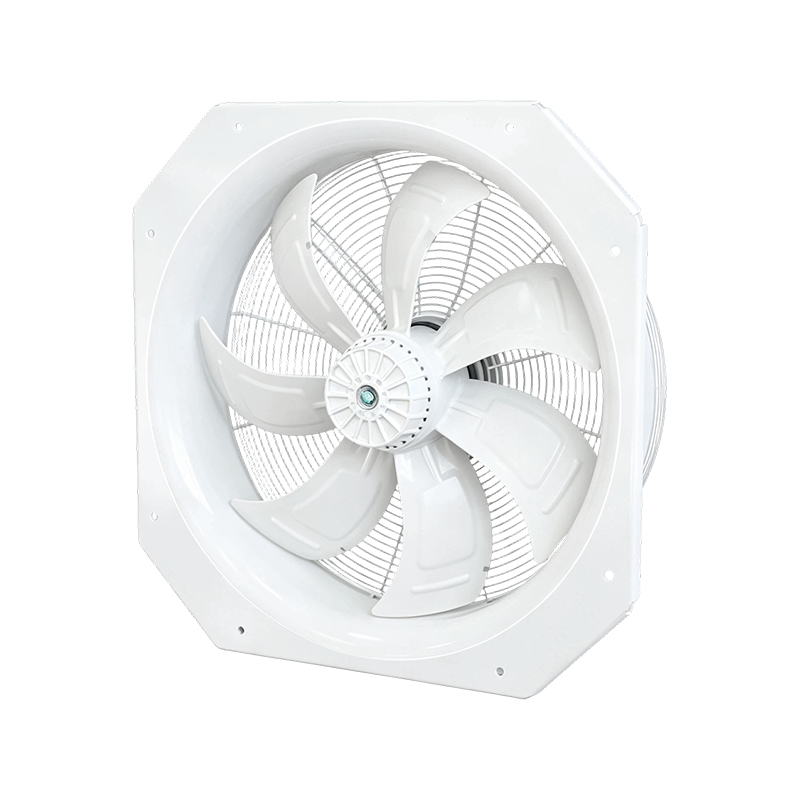 800mm Industrial AC Axial Fan with Seven Metal BladesHigh-airflow axial fan for panel, cabinet and condenser cooling, with seven CFD-optimized metal blades, corrosion-resistant finish options and customizable voltage, wiring and panel size.View Product →
Where a Centrifugal Blower Earns Its Keep
The scroll housing is the secret. By converting velocity into static pressure, a centrifugal blower can keep pushing air through a system that actively resists it: HEPA filter packs, long or convoluted duct runs, dense heat exchanger coils, air-handling units. Because the discharge can be aimed into a plenum or a rectangular duct, blowers are also the natural choice when the air has to go somewhere specific rather than simply out of the box.
The impeller shape refines that behaviour further:
- Forward-curved impellers are compact and move a lot of air at moderate pressure, which keeps them popular in air handling and appliance ventilation.
- Backward-curved impellers are more efficient, self-cleaning in dirty airstreams and less likely to overload the motor when resistance rises, so they suit filters, FFU units and continuous duty.
- Radial impellers handle very high pressure and abrasive or particulate-laden air.
The trade-off is size and cost. A blower needs a housing, a discharge path and more careful balancing, so it is a bigger, heavier and more expensive component. In a ducted system it is also usually the quieter one, simply because it is not straining against back pressure.
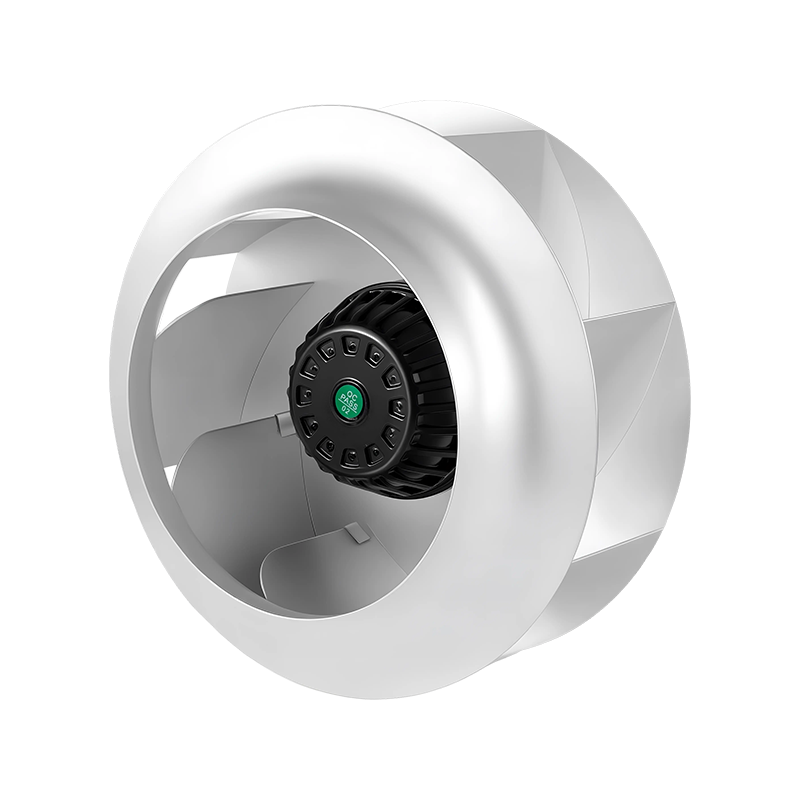
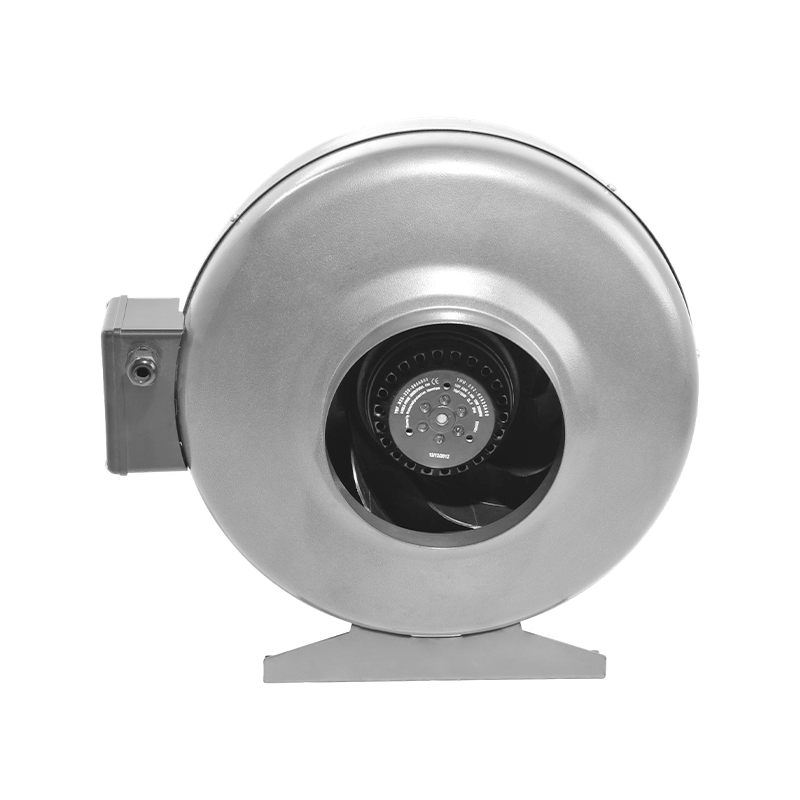
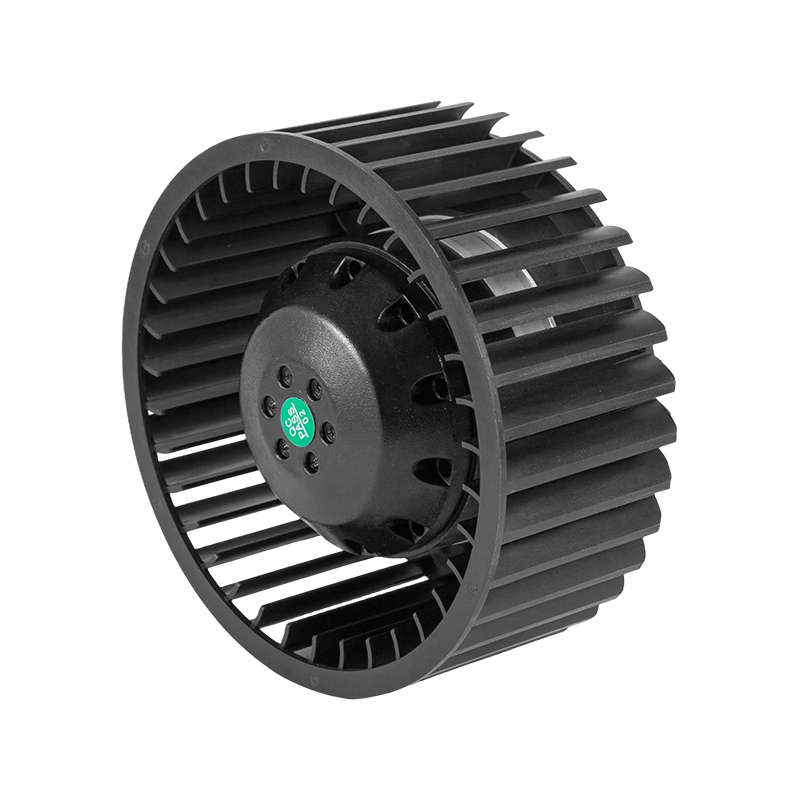 Industrial AC Forward Curved Centrifugal BlowerLarge-air-volume centrifugal blower for roof fans and HVAC units, designed to overcome long ductwork and dense filters with high static pressure and a compact housing.View Product →
Axial Fan vs Centrifugal Blower: A Side-by-Side View
The table below summarises the comparison in the form we usually sketch on a whiteboard during a first call. Treat it as a starting filter, not as a final specification.
| What you are comparing | Axial fan | Centrifugal blower |
|---|---|---|
| Air path | Straight through, in line with the shaft | In at the hub, out at 90 degrees through the scroll |
| Best at | High airflow against low resistance | Moderate airflow against high resistance |
| Static pressure | Low to moderate | High, often several times higher |
| Efficiency in free air | Very good | Lower |
| Efficiency behind filters or long ducts | Falls away quickly | Holds up across a wide range |
| Noise behaviour | Quiet in free air, louder when throttled | Quieter behind filters and duct work |
| Space and mounting | Slim, panel-mount friendly | Larger housing, needs discharge clearance |
| Relative cost | Lower | Higher |
| Typical duties | Panel cooling, condensers, wall ventilation | FFU, filter packs, heat pumps, ducted supply |
Matching the Type to the Job
Open air, cabinets and coils
If the air is simply being circulated, exhausted or blown across a coil with clear space behind it, an axial fan is almost always the sensible answer. Cooling towers, cold-chain condensing units, machine enclosures and wall-mounted ventilation all fall into this group.
Ducts, filters and pressure
Once the air has to travel, a blower takes over. The moment you sketch a filter, a bend, a grille or several metres of duct, you have added resistance, and resistance is what a centrifugal impeller is built to handle. The same applies to air purification and FFU work, where high static pressure and low noise have to coexist.
HVAC and ventilation systems
Most real installations use both. An air handling unit might pair a backward-curved blower on the supply side with axial fans on the condenser. If you are working through that combination, our overview of air conditioning and ventilation applications shows how the two families sit side by side in the same system.
The Drive Matters as Much as the Blade
Blade geometry is only half the decision. The motor behind it determines how the unit is controlled, how efficient it is at part load and how easily it fits into a building management system.
AC motors remain the simplest, most robust and most cost-effective option. They run directly from mains voltage, need no control electronics, and in external rotor designs they keep the whole assembly compact.
EC motors are electronically commutated and increasingly the default in energy-conscious projects. They accept 0–10 V or PWM control, hold efficiency well below full speed and can often be dropped into a housing that previously held an AC motor, which makes them a practical retrofit for ventilation upgrades.
DC and BLDC motors suit low-voltage equipment, telecom cabinets and battery-backed systems, where 24 V or 48 V rails and fine speed control matter more than mains simplicity.
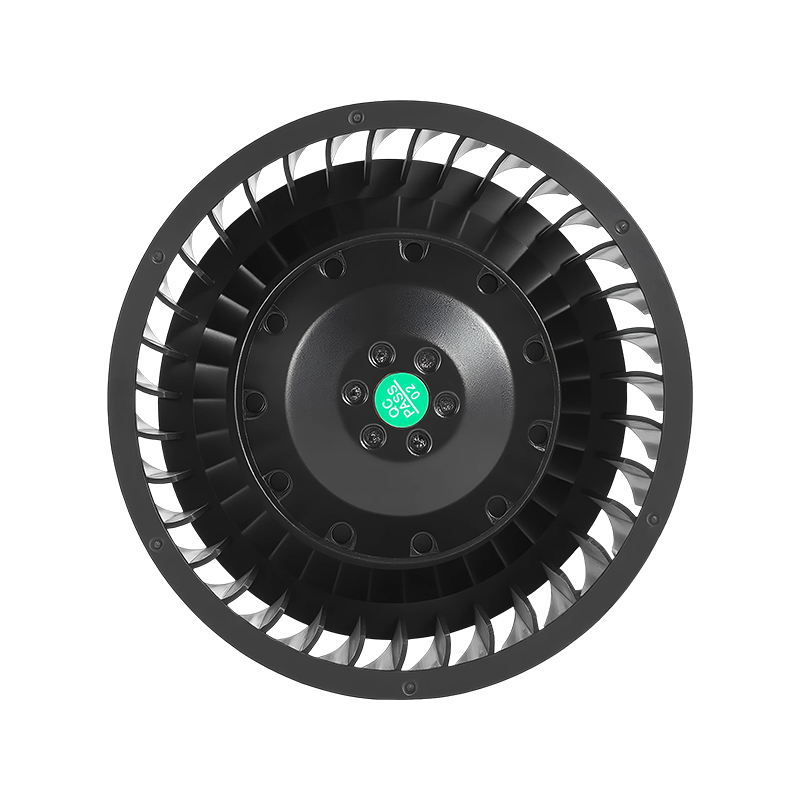
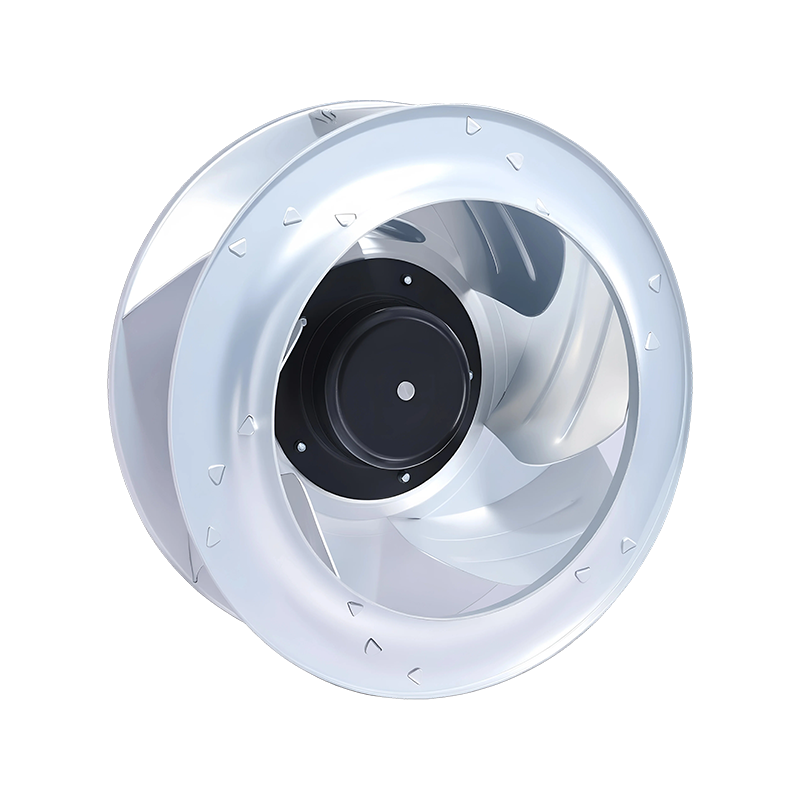 High-Efficiency EC Backward Curved Centrifugal FanEC centrifugal fan for HVAC replacement and sustainable air movement, with configurable voltage, control signals and mounting details plus long-life ball bearings.View Product →
A Five-Minute Selection Checklist
- Define the duty point properly: the airflow you need at the real system resistance, not the free-air figure printed on the label.
- Estimate the resistance: filters, coils, duct length, bends, grilles and discharge restrictions all add up.
- Plot both the fan curve and the system curve. The intersection is where the unit will actually run.
- Compare noise at that operating point, not at the best-efficiency point.
- Check the envelope: supply voltage, control signal, ambient temperature, IP rating, mounting orientation and the space available for discharge.
- Verify with a sample before committing to tooling, ideally on a calibrated wind tunnel with a noise measurement alongside it.
Mistakes We See Most Often
- Specifying from a free-air airflow figure and then wondering why the ducted system delivers a fraction of it.
- Fitting a centrifugal blower into an enclosure with no room behind the discharge, which strangles the scroll.
- Bolting an axial fan directly to thin sheet metal without considering resonance and inlet obstruction.
- Buying on purchase price alone and paying the difference in energy and replacement labour over the service life.
Most of these are avoidable at the drawing stage. We test fan curves in a wind tunnel and confirm acoustic behaviour in a noise laboratory before a model is released, which is exactly why the questions above come up so early in our own design reviews.
Final Thoughts
Axial fans and centrifugal blowers are not competitors so much as two answers to different questions. If the system is open and the priority is volume per dollar, go axial. If the system resists and the priority is pressure without noise, go centrifugal, and choose the impeller curve carefully. Everything after that is detail: motor type, control, envelope and verification.
If you want to go deeper on impeller geometry and duty-point matching, our centrifugal blower selection guide covers the curve work step by step. And if you are still weighing the two shapes against a specific installation, send us the duty point and a sketch of the air path — we are always happy to talk it through.
NEXT:Heavy Industrial Fan Failures in Extreme Environments: Prevention & Design
Interested in cooperation or have questions?
-

sale3@beron-motor.com
-
 +86-15906637529
-
 Building 1 (12#), No. 619, Wangmei Road, Linping Street, Yuhang District, Hangzhou, China
 Wholesale Industrial Fan Manufacturers