
 English
 русский
 Español
 عربى


Product Category
News Categories
Contact Us
Types of Centrifugal Fans: A Practical Guide to Blades, Drives and Selection
Content
Centrifugal fans sit behind a lot of equipment people rarely think about: air handlers, heat pumps, fume extraction, rack cooling, pneumatic conveying. If you are specifying one, the most consequential decision you will make is the blade type. It sets the airflow, the static pressure, the noise level, the power draw, and how gracefully the fan copes with a dirty airstream.
Here is how we walk customers through the main types of centrifugal fans — what each impeller does well, where it struggles, and which drive usually suits it.
What Actually Separates One Fan Type From Another
Every centrifugal fan works the same way. Air enters the centre of the impeller, is caught between the blades, and is thrown outward by centrifugal force. The scroll-shaped housing then slows that fast-moving air down and converts velocity into static pressure — the push needed to move air through filters, coils, long duct runs and densely packed equipment racks.
The blade angle is what makes the difference between one family and the next. Forward-leaning blades give you a lot of air at modest pressure from a small wheel. Backward-leaning blades trade some airflow for efficiency. Straight radial blades give you a wheel that survives dust, chips and heat.
Three numbers decide the rest: airflow in CFM or m³/h, the static pressure the system demands, and the condition of the air at that point in the system.
The Main Types of Centrifugal Fans
Catalogues usually group centrifugal wheels into four blade families. If you have already read about forward-curved, backward-curved and radial blowers, the table further down puts the numbers side by side.
Forward-Curved Fans
Forward-curved impellers use many shallow blades tilted in the direction of rotation. They move a large volume of air at low to medium pressure while turning slowly, which keeps them compact and quiet for their size. That is why they turn up in fan coil units, small air handlers, range hoods and appliance blowers.
The trade-off is efficiency and dirt tolerance. A forward-curved wheel wants clean air; dust settles on those shallow blades, unbalances the wheel, and takes the bearings out with it. In filtered, modest-pressure duty, it remains a very cost-effective choice.
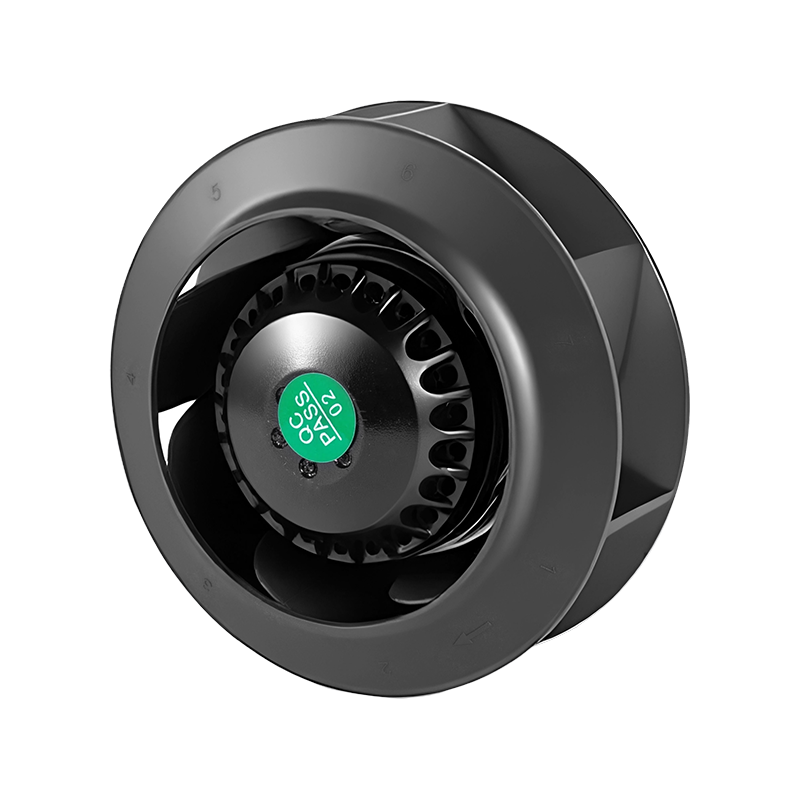
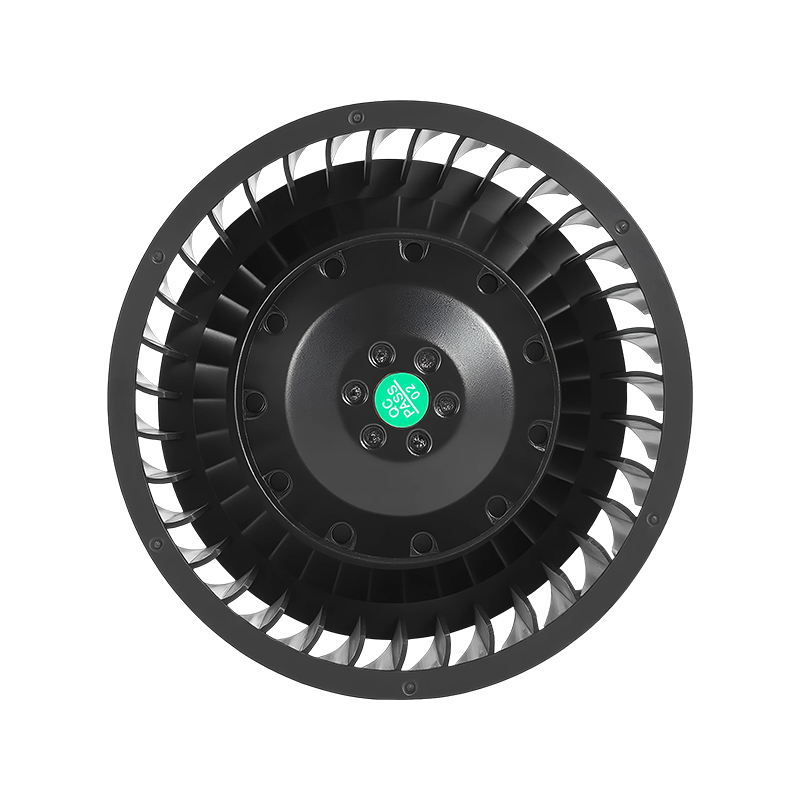
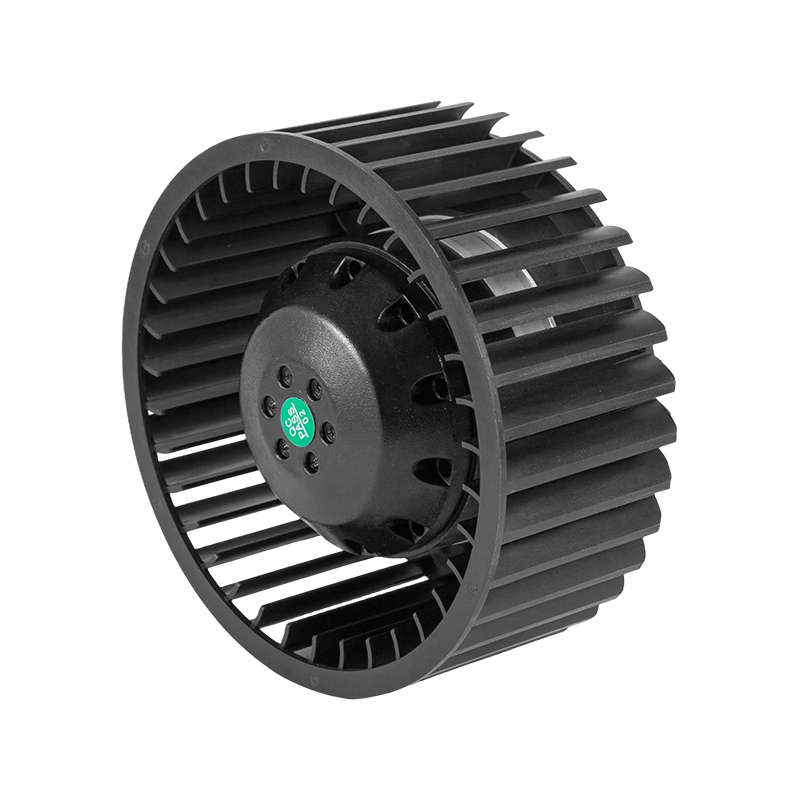 AC Forward Curved Centrifugal Blower for HVACThis AC forward-curved centrifugal blower suits roof fans and HVAC units, offering compact high-static-pressure ventilation; review it as the forward-curved choice discussed above.View Product →
Backward-Curved and Backward-Inclined Fans
Backward-curved blades lean away from the direction of rotation. The wheel runs faster and moves less air per revolution, but converts motor power into pressure far more efficiently. The shape also resists dust build-up. Backward-inclined wheels use flat blades and are a close relative; airfoil wheels take the idea further with hollow, wing-shaped blades.
This family covers most clean-air HVAC work, including air purification and FFU cabinets where high static pressure and low noise matter at the same time.
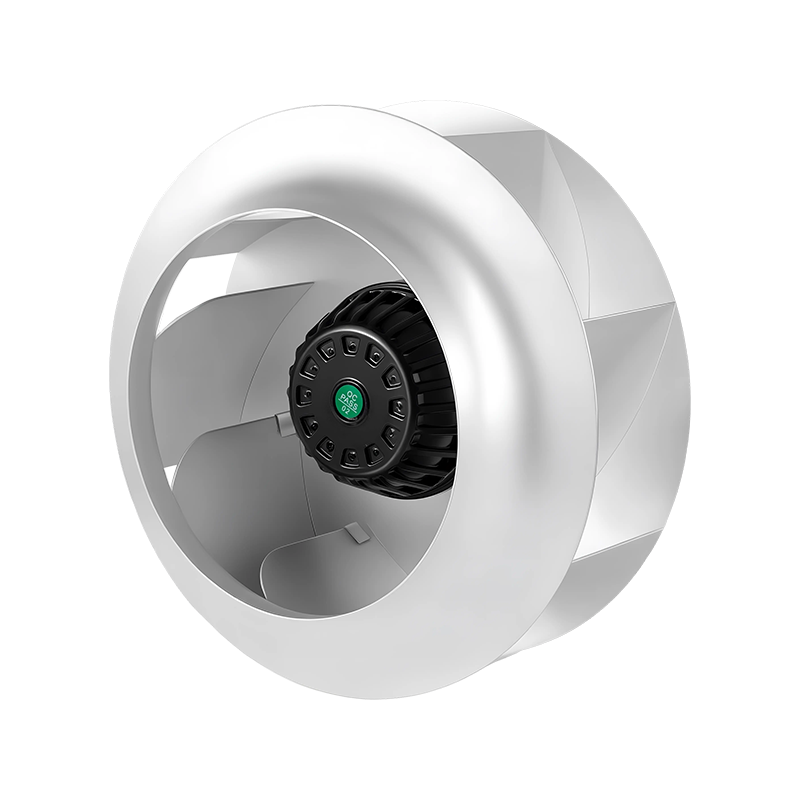
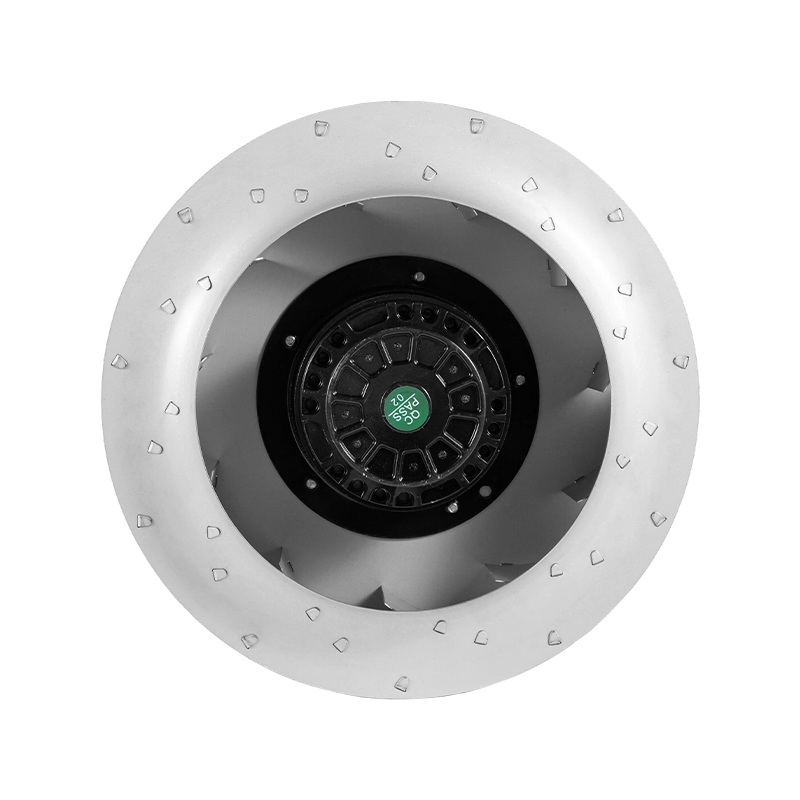 Durable Metal AC Backward Centrifugal Fan for FFUThis durable metal AC backward centrifugal fan supports FFU, cleanroom and industrial filtration duties, making it a relevant clean-air HVAC option before radial-wheel applications.View Product →
Radial (Straight-Blade) Fans
Radial wheels have blades standing straight out from the hub. They are the least efficient of the four, but nothing else handles abuse as well. There is nowhere for material to lodge, so radial fans are the standard answer for dust collection, wood and metal chips, welding fume and hot exhaust. Radial-tip versions give slightly better efficiency while keeping the open, self-clearing shape.
Airfoil Fans
Airfoil impellers use hollow blades shaped like wings and reach the highest efficiency of any centrifugal design. They are also the least forgiving — clean air only, and repairs are costly. Large commercial air handling systems with long running hours are where they pay for themselves.
Types of Centrifugal Fans at a Glance
| Blade type | Typical efficiency | Pressure | Best suited to | Main caution |
|---|---|---|---|---|
| Forward-curved | Low to medium | Low to medium | Compact air handlers, fan coils, appliances | Dust build-up and imbalance |
| Backward-curved / inclined | Medium to high | Medium to high | HVAC supply air, FFU, air purification | Needs reasonably clean air |
| Radial (straight blade) | Low | High | Dust, chips, fume, high-temperature exhaust | Noise and power draw |
| Airfoil | High | Medium to high | Large clean-air systems with long run hours | Cost and clean-air requirement |
Drive Options: AC, EC and DC
The impeller is only half the specification. The motor behind it decides how the fan behaves in service.
- AC fans — a mains-powered induction motor, often with an external rotor. Simple, robust and easy to service, with limited speed control.
- EC fans — brushless DC motors with the electronics built in. They accept a 0–10 V or PWM signal for stepless speed control and use noticeably less power at part load, which is why they are such a common upgrade path for equipment that runs continuously.
- DC fans — 12 V, 24 V or 48 V operation for battery systems, vehicles, telecom cabinets and other DC-bus equipment.
Because EC and DC units are built around BLDC motors with integrated drivers, they also bring protection features such as overvoltage and reverse-polarity handling, plus efficiency levels that meet IE4 or IE5 expectations.
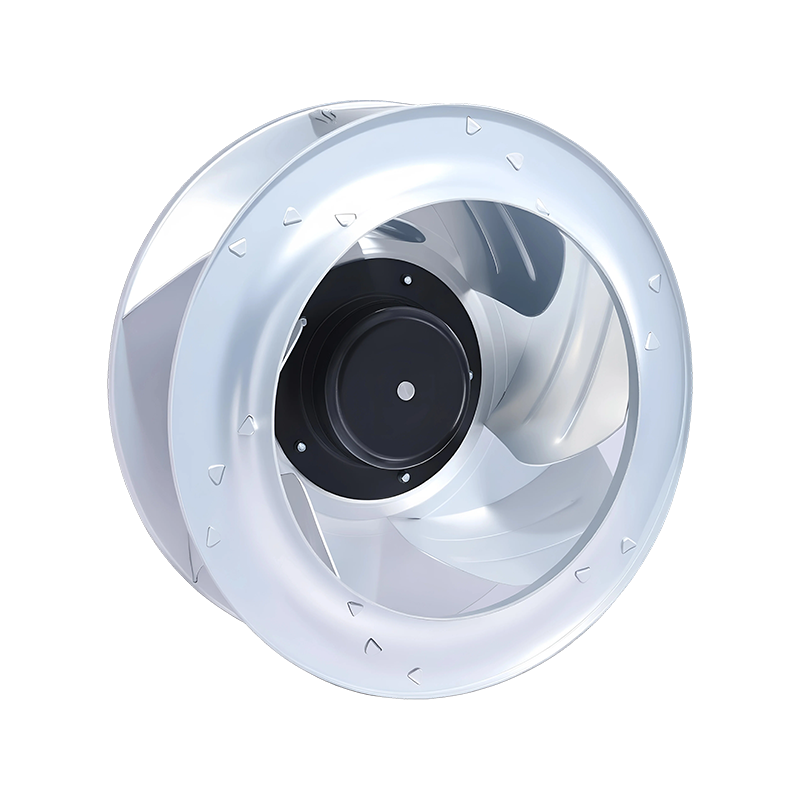 High-Efficiency EC Backward Curved Centrifugal FanThis EC backward-curved fan offers customizable voltages, controls, and structural options with long-life bearings, making it worth reviewing as a high-efficiency replacement for HVAC systems.View Product →
How to Choose the Right Type
- Start with airflow and static pressure. Plot your duty point first. A fan that is oversized will run far from its best efficiency point, wasting power and adding noise.
- Look at the airstream. Clean and filtered air points towards backward-curved or airfoil. Dusty, sticky or abrasive air points towards radial.
- Check the environment. Ambient temperature, humidity, corrosive vapour and IP requirements narrow the list quickly.
- Compare running cost, not just purchase price. On a fan running 8,000 hours a year, a few points of efficiency outweigh a small difference in unit price.
- Decide the control strategy early. If you need part-load speed control, choose an EC fan rather than throttling a fixed-speed one.
- Mind noise and space. Forward-curved wheels are often the quieter option at equal duty, though they may need a larger housing.
Mistakes We See Most Often
- Buying on unit price alone and ignoring the energy bill over years of continuous running.
- Specifying a forward-curved wheel for an airstream that carries dust or grease.
- Judging static pressure from a free-air airflow figure instead of the system curve.
- Ignoring duty cycle, insulation class and thermal protection in hot enclosures.
- Forgetting that a fan running far from its best efficiency point is both loud and unreliable.
Where These Fans Turn Up
In practice, the blade and drive choices repeat themselves across a handful of industries. Centrifugal fans sit inside air conditioning and ventilation equipment, refrigeration and cold-chain cabinets, household appliances, power electronics, IT and communication enclosures, air purification units and energy storage systems. In every case the question is the same: how much air, against how much resistance, and how clean is it?
Questions We Get Asked
Forward-curved or backward-curved — which one do I need?
If your system runs clean, needs moderate pressure and space is tight, forward-curved is often enough. If you need higher static pressure, better efficiency or part-load speed control, go backward-curved.
Which type copes best with dirty air?
Radial. The open, straight blades let material pass through instead of collecting on the wheel.
Are EC centrifugal fans worth the extra cost?
For equipment that runs most of the day, usually yes. The efficiency gain and the ability to slow the fan down when full airflow is not needed tend to pay back the difference.
Choosing among the types of centrifugal fans is really about matching the wheel to your duty point, your air quality and your control strategy. Get those three right and the fan becomes one of the least troublesome parts of the machine. If you would like a second opinion on a specification, our engineers are happy to look at your airflow, pressure and space figures and suggest a wheel and drive combination that fits.
NEXT:Corrosion Resistant Air Movement Systems: A Practical Fan Selection Guide
Interested in cooperation or have questions?
-

sale3@beron-motor.com
-
 +86-15906637529
-
 Building 1 (12#), No. 619, Wangmei Road, Linping Street, Yuhang District, Hangzhou, China
 Wholesale Industrial Fan Manufacturers