
 English
  русский
  Español
  عربى
عربى 

Product Category
News Categories
Contact Us
Corrosion Resistant Air Movement Systems: A Practical Fan Selection Guide
Content
- 1 What Corrosion Resistance Actually Means for a Fan
- 2 Four Environments That Punish Air Movement Equipment
- 3 Materials and Construction Choices That Matter
- 4 Motor, Winding, and Drive Protection
- 5 Matching Fan Type to the Air Path
- 6 EC and Variable Speed: Efficiency as a Corrosion Strategy
- 7 Installation and Maintenance Habits That Extend Service Life
- 8 Specifying the Right System for Your Air
Air that carries salt, ammonia, chlorine, sulfur, or nothing more exotic than constant condensation will eventually find every unprotected surface in a fan. A painted steel housing blisters, a bearing seizes, a terminal block turns green, and a unit that was specified for ten years of service is replaced in eighteen months. That is why corrosion resistant air movement systems should never be bought as a single component decision. The impeller, housing, motor, bearings, wiring, and controls all have to survive the same air.
Beron Motor designs and manufactures axial fans, centrifugal fans, duct fans, and BLDC motors for HVAC, refrigeration, electric power, IT communication, household appliances, and similar duty. Most of the premature failures we are asked to diagnose are not mysterious motor faults. They are corrosion stories that start small: a scratch in a coating, a fastener of the wrong grade, a drain hole placed on the wrong side of a casing.
What Corrosion Resistance Actually Means for a Fan
"Corrosion resistant" is not a single certificate you can buy. It is a set of decisions that line up with the specific air the fan will move. Before choosing anything, it helps to answer four plain questions:
- Which surfaces touch the air stream, and what is that air carrying?
- What happens when the fan stops and the moisture stays inside the casing?
- Is the equipment washed, hosed, or chemically cleaned during normal operation?
- Does the installation sit indoors, in a plant room, or outdoors near a coast?
Answer those honestly and the material list almost writes itself. Skip them and the cheapest fan on the quote sheet usually becomes the most expensive one on the maintenance log.
Four Environments That Punish Air Movement Equipment
In practice, most corrosion enquiries we receive come from four directions, and each one fails equipment in a different way.
- Coastal and marine air. Chloride attacks aluminium and ordinary steel fasteners. Aluminium fans can still work here, but the alloy, the coating thickness, and the fastener grade have to be chosen deliberately rather than by default.
- Refrigeration and cold chain duty. Coils, defrost cycles, and washdown water create repeated wet-dry cycles. Condensation forms inside the casing when the fan stops, which is exactly when nobody is watching. Our refrigerated and cold chain selections are usually specified around moisture cycling rather than peak airflow.
- Power and electrical rooms. Humid air, dust, and occasional sulfur-bearing gases from nearby processes attack terminals and lead wires. Electric power ventilation tends to need protected terminals, sealed cable entries, and stable insulation more than exotic alloys.
- Chemical, plating, wastewater, and food processing exhaust. Acid vapour and alkaline washdown are the hardest cases. If the air is chemically aggressive, the fan is a consumable unless the wetted parts are matched to that chemistry.
Materials and Construction Choices That Matter
Once you know what the air contains, the design conversation becomes concrete. The table below is the checklist our engineers run through during selection, and it is a useful one to keep beside any quotation you review.
| Component | Typical weak point | Corrosion-resistant direction |
|---|---|---|
| Impeller | Thin blades and untreated cut edges | Backward-curved metal or coated aluminium with smooth surfaces that shed deposits |
| Housing | Cut edges and drains in the wrong place | Powder coating over phosphated steel, sealed seams, drains at the lowest point |
| Fasteners | Standard zinc-plated screws | Stainless steel or coated hardware matched to the environment |
| Motor winding | Moisture reaching the copper | Class F insulation, full copper winding, quality impregnation, drip-proof construction |
| Bearings | Water ingress and grease washout | Sealed ball bearings with moisture-tolerant grease |
| Terminals and leads | Humid air on exposed contacts | Protected terminal boxes, sealed entries, overvoltage and reverse polarity protection |
| Enclosure overall | No defined ingress protection | An IP rating that matches the real washdown and dust regime |
Motor, Winding, and Drive Protection
A fan can have a beautifully coated housing and still fail because the motor was never designed for damp air. Winding insulation class, impregnation quality, bearing seals, and terminal protection do far more for service life in humid duty than an extra fraction of a millimetre of paint. In our own motor range we combine class F insulation with full copper windings and sealed bearings, and we test moisture and thermal behaviour in an ageing laboratory rather than trusting a datasheet value alone.
Electronics deserve the same attention. A DC centrifugal blower running on 24 V or 48 V in a wet plant room needs protection against a mis-wired supply, because one mistake during a night shift should not end the life of the unit.
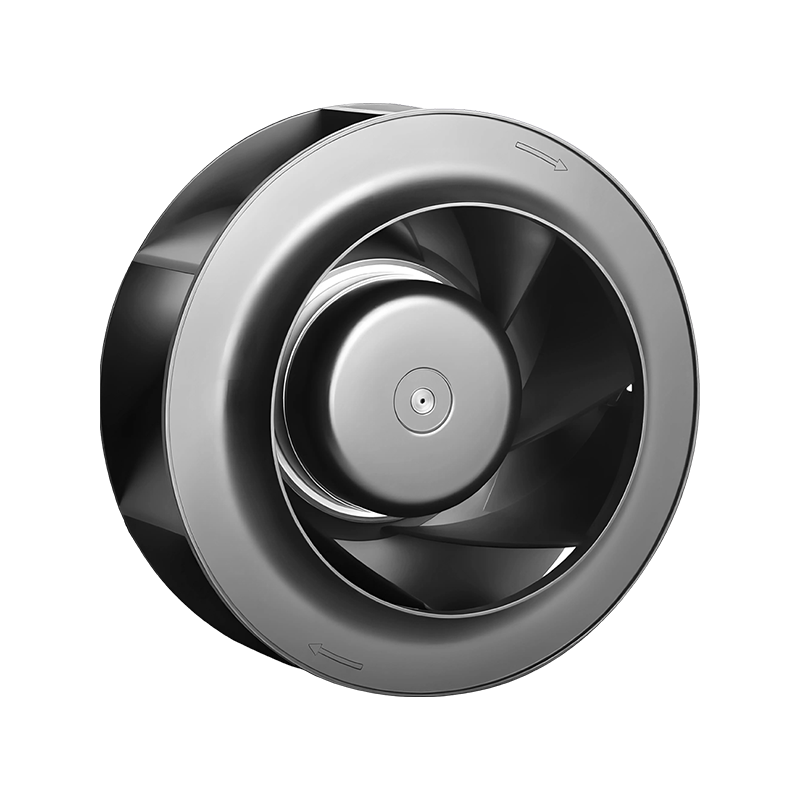 24 VDC Centrifugal Exhaust Fan with Fault Output and Speed MonitoringFor wet plant rooms, this fan provides reverse-polarity protection, over-voltage protection, and real-time speed monitoring, with multi-fan networking for uniform control.View Product →
Matching Fan Type to the Air Path
Corrosion resistance also depends on how air and particles travel through the fan, because that decides where moisture and contaminants settle.
- Axial fans move large volumes at low pressure and are easy to clean, which suits open ventilation where the air is aggressive but system resistance is low.
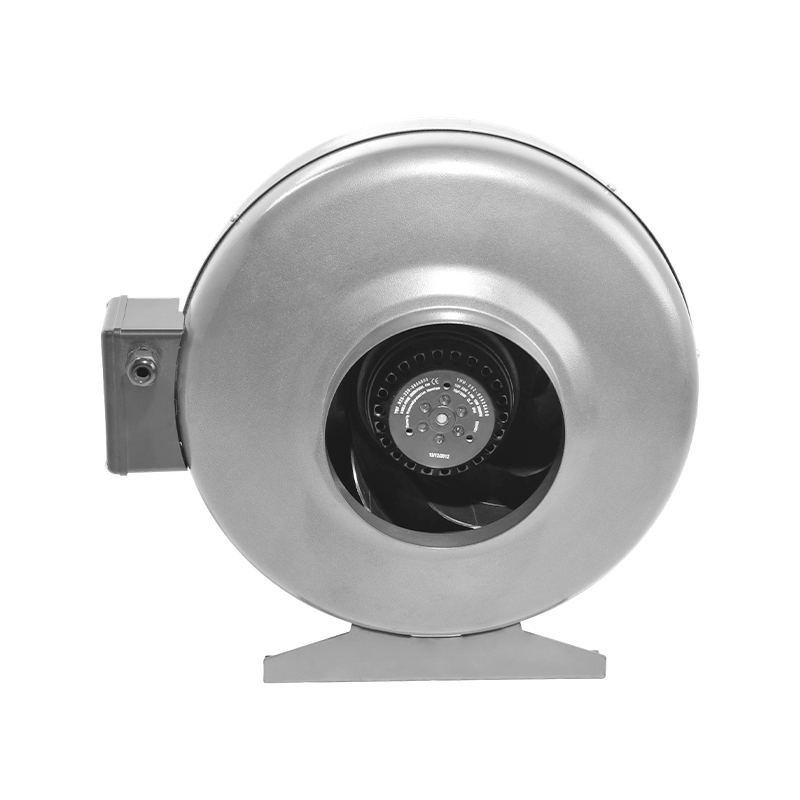
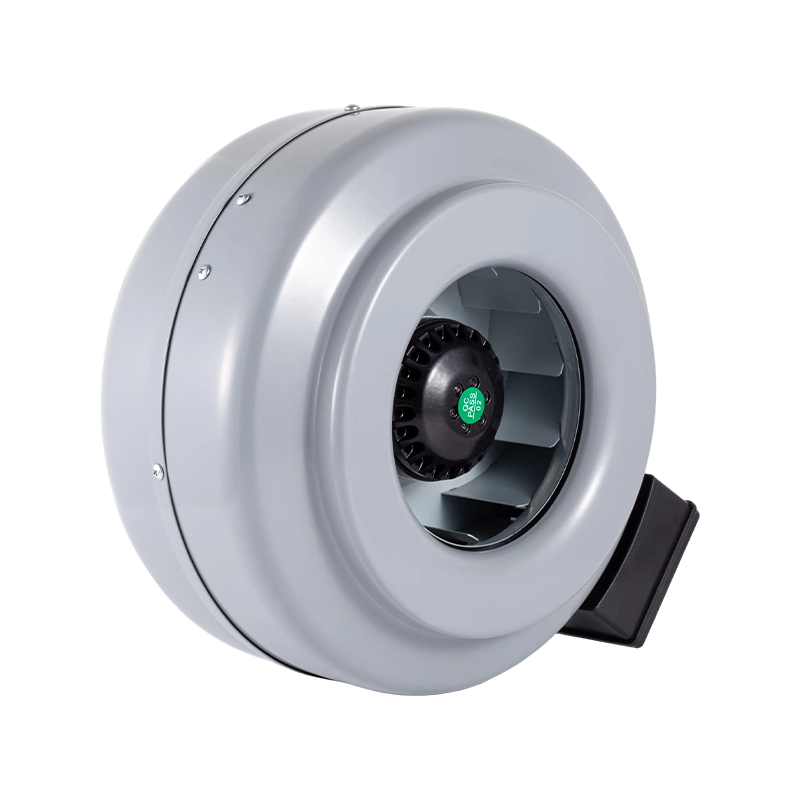
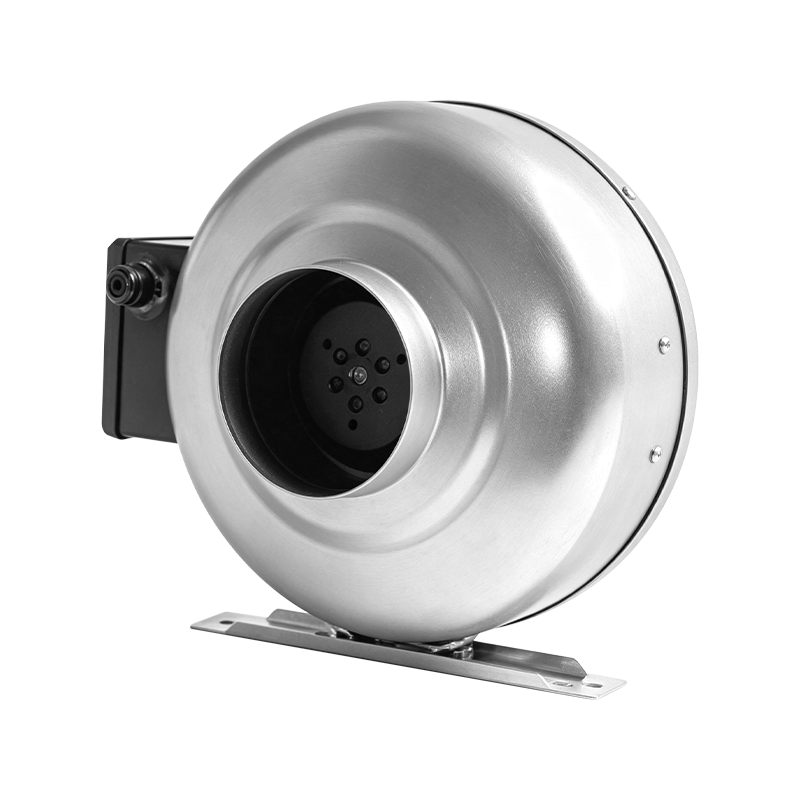
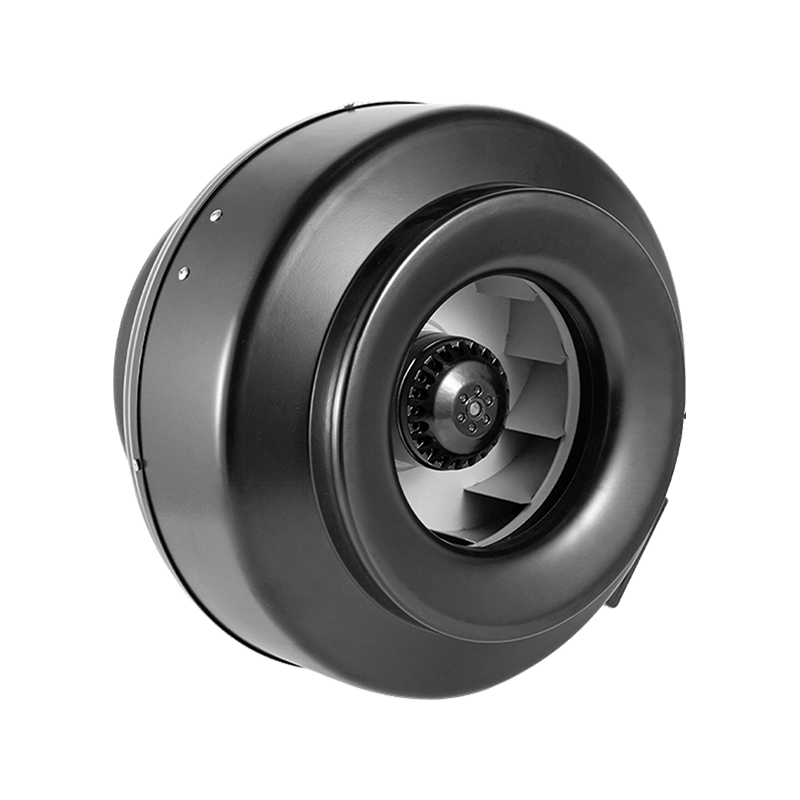
- Duct fans sit inline in the ductwork, so the motor sits inside the air stream. In humid or dusty ducts that means sealed motors and a casing that will not trap water.
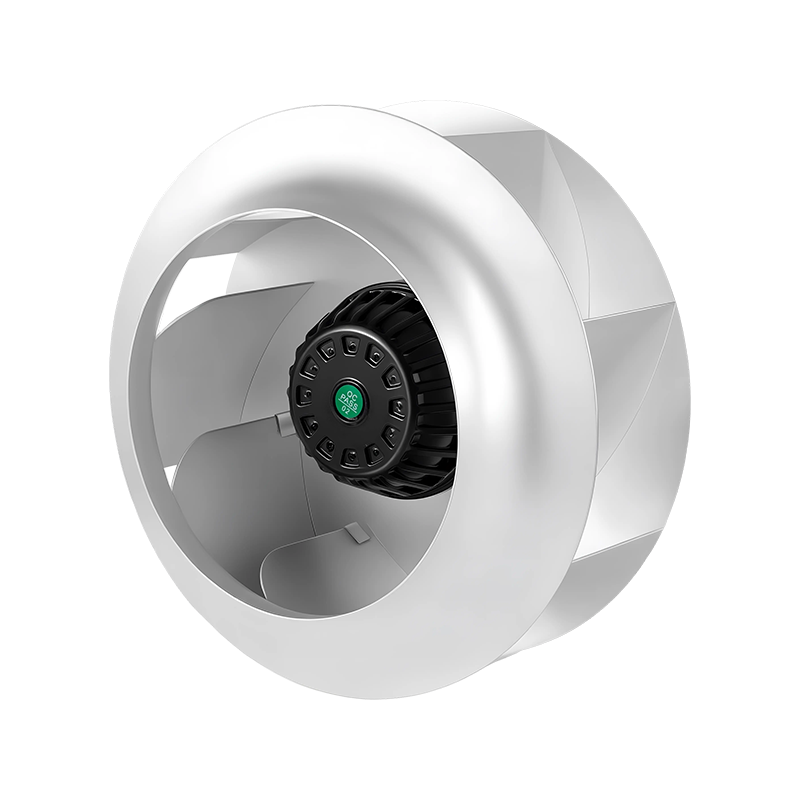
- Centrifugal fans handle higher static pressure, which is what you need when air passes through filters, coils, or long duct runs. Backward-curved impellers tolerate deposits better than forward-curved types, because the blade geometry tends to self-clean instead of collecting material.
Where a ducted system runs a long distance through a humid plant, we usually look at a backward-curved, IP-rated duct fan with a defined drain path rather than a standard inline unit.
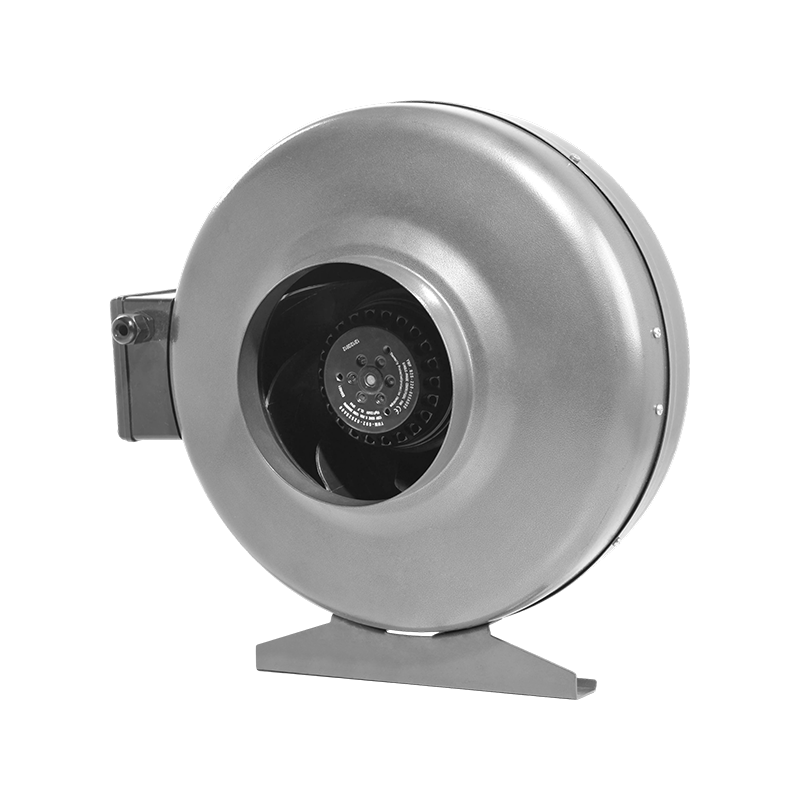 IP44 Backward-Curved AC Duct Fan for Long Duct RunsThis high-static-pressure duct fan suits humid plants and long runs, with backward-curved impeller, flange joints for standard ducts, and plug-and-play installation.View Product →
EC and Variable Speed: Efficiency as a Corrosion Strategy
It sounds like a stretch, but efficiency and corrosion resistance are linked. An EC fan with stepless 0 to 10 V control runs only at the speed the system actually needs, so the motor and bearings run cooler at part load, the insulation is under less thermal stress, and lubricant lasts longer. When an ageing AC unit is replaced with an EC equivalent, the gain is usually both energy and a longer interval between failures.
Outdoor equipment such as air source heat pumps is a good example. The fan sits in rain, night-time condensation, and airborne pollutants for years, and the drive electronics have to keep working through all of it without drifting out of balance.
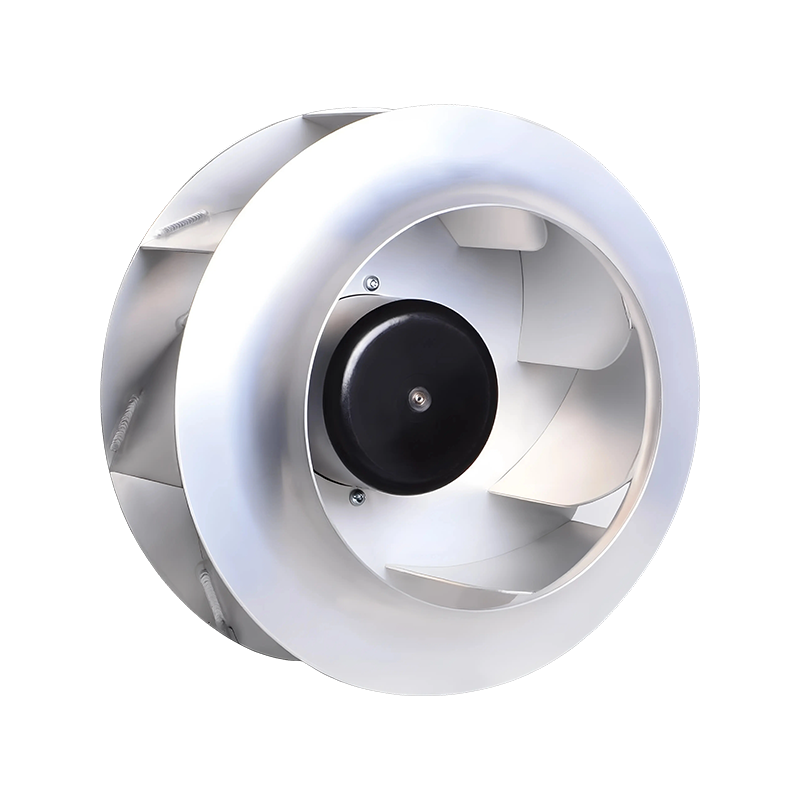 IP54 EC Centrifugal Fan for Air Source Heat PumpsDesigned for outdoor heat pumps, this EC fan offers IP54/IP55 protection, wide temperature range, and long-life bearings for reliable year-round operation.View Product →
Installation and Maintenance Habits That Extend Service Life
Even a well-specified fan can be undone by installation. These habits cost very little and change the outcome more than most buyers expect.
- Mount the fan above splash and standing-water zones, then re-check the drain holes after installation rather than trusting the drawing.
- Place filtration ahead of the fan where possible, so the impeller sees less dust and fewer corrosive particles.
- Clean impellers on a schedule instead of after a vibration complaint, since deposits hold moisture against the metal.
- Record vibration, current draw, and bearing temperature at fixed intervals so a slow decline is noticed early.
- Refresh gaskets, seals, and terminal covers after any maintenance that opens the casing.
- Keep a spare unit or spare motor for critical exhaust lines, because the replacement arrives long after corrosion has reached the ductwork.
Specifying the Right System for Your Air
Corrosion resistant air movement systems are built from ordinary engineering decisions made in a deliberate order: understand the air first, choose materials second, match the motor and controls third, and plan how the installation will drain and be maintained last. Getting that order right is the difference between a fan replaced twice a decade and one replaced twice a year.
Beron Motor supports that process with wind tunnel, noise, motor performance, and ageing laboratories across our Hangzhou and Huzhou facilities, ISO 9001:2015 quality management, and products carrying CCC and CE certification with ROHS and UL testing. If you can describe the air, the temperature, and the cleaning routine, our engineers can propose a fan and motor combination built to survive it.
NEXT:Centrifugal Blower Selection Guide: Airflow, Pressure, and Drive Types
Interested in cooperation or have questions?
-

sale3@beron-motor.com
-
 +86-15906637529
 -
 Building 1 (12#), No. 619, Wangmei Road, Linping Street, Yuhang District, Hangzhou, China
 Wholesale Industrial Fan Manufacturers