
 English
 русский
 Español
 عربى


Product Category
News Categories
Contact Us
Centrifugal Fan Blades: How Blade Shape, Motor and Drive Affect Airflow and Pressure
Content
- 1 What Centrifugal Fan Blades Actually Do
- 2 Forward, Backward and Radial: The Main Blade Families
- 3 Forward-Curved Blades: Compact Air Movers
- 4 Backward-Curved Blades: Efficient Pressure Builders
- 5 Blade Details That Change Airflow and Pressure
- 6 Matching Blade Profile to Motor and Drive
- 7 Materials, Balance and Noise
- 8 Common Selection and Maintenance Mistakes
- 9 Choosing Centrifugal Fan Blades for Your Application
Centrifugal fan blades are the quiet deciding factor in a fan's personality. Two units can share the same motor, housing and nominal size, yet one moves air gently through a filter bank while the other struggles against duct pressure. The difference usually comes down to impeller geometry: blade curve, blade count, width, diameter and the way the wheel meets the inlet. If you specify, build or maintain centrifugal fans, understanding blades makes selection less mysterious and troubleshooting much faster.
What Centrifugal Fan Blades Actually Do
Air enters the impeller eye, turns roughly ninety degrees, and is flung outward by the rotating blades. The volute casing collects that high-velocity air and converts much of it into static pressure. Blades guide this energy transfer. A forward-curved blade can move a lot of air at low speed, but it is sensitive to dirty filters and system resistance. A backward-curved blade trades some raw airflow for higher efficiency and a more forgiving pressure curve. Radial blades handle harsh duties where solids or high temperatures may be present. The blade is therefore not a cosmetic detail; it sets the shape of the fan curve.
Forward, Backward and Radial: The Main Blade Families
The table below gives a practical starting point. It is general guidance, not a substitute for a certified fan curve at your actual duty point.
| Blade profile | Typical airflow | Static pressure | Efficiency | Common fit |
|---|---|---|---|---|
| Forward-curved | High at low speed | Moderate | Lower | Compact HVAC, appliances, FFU |
| Backward-curved | Moderate to high | High | High | Clean-air AHU, FFU, heat pumps |
| Radial | Moderate | High | Moderate to lower | Industrial exhaust, dirty or high-temperature air |
| Airfoil backward-curved | High | High | Highest | Large AHU, efficient ventilation |
Forward-Curved Blades: Compact Air Movers
Forward-curved wheels use many shallow blades that lean in the direction of rotation. They are often made from galvanized steel or plastic and are common in compact air handlers, fan coils, appliance cooling and FFU packages. Their advantage is airflow density: a small wheel can deliver useful volume at modest speed. The trade-off is a steeper pressure curve and lower peak efficiency. They also dislike imbalance and filter loading, so clean airflow and good inlet conditions matter. If a forward-curved fan sounds harsh or loses airflow quickly, check for a blocked filter, a collapsed duct or a wheel packed with dust before blaming the motor.
Backward-Curved Blades: Efficient Pressure Builders
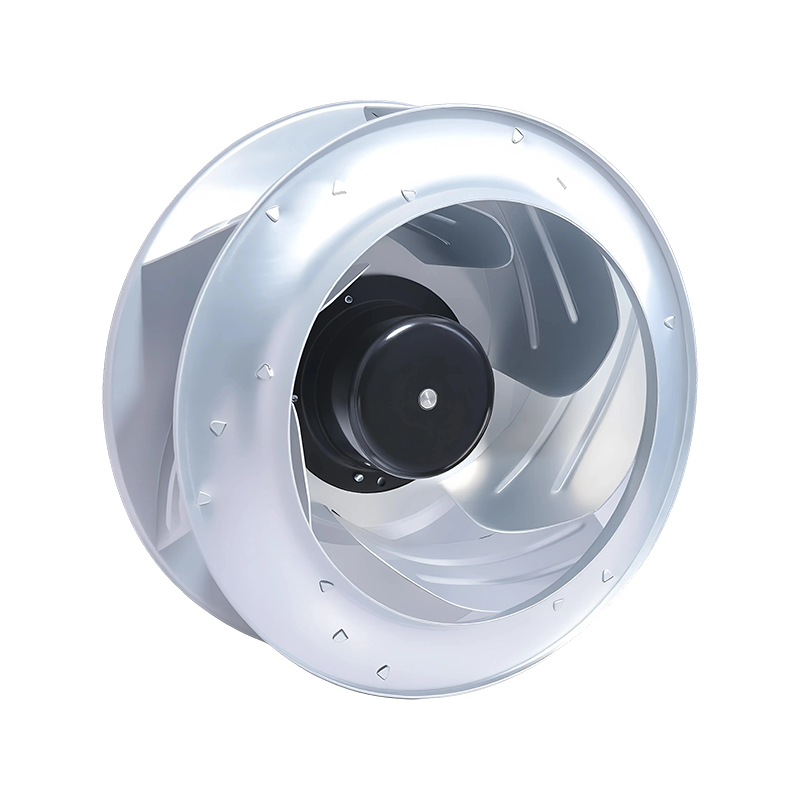
Backward-curved blades lean away from rotation. They are available in single-width and double-width wheels, with plain or airfoil sections. This profile is the workhorse of clean-air HVAC, FFU and heat-pump duty because it combines good efficiency with a stable pressure curve. It tolerates modest system resistance better than a forward-curved wheel and is less likely to overload the motor as filters load. The blades are often sheet metal, welded or riveted to a hub and backplate, and balanced as a complete impeller. A well-made backward-curved wheel can be quiet, but only if the inlet clearance and cut-off position are right.
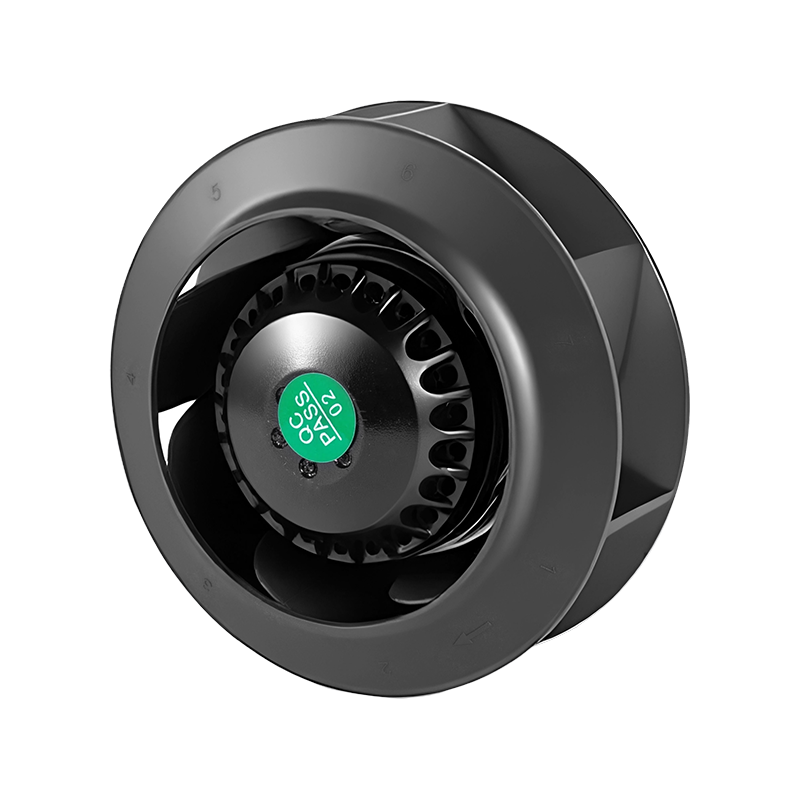
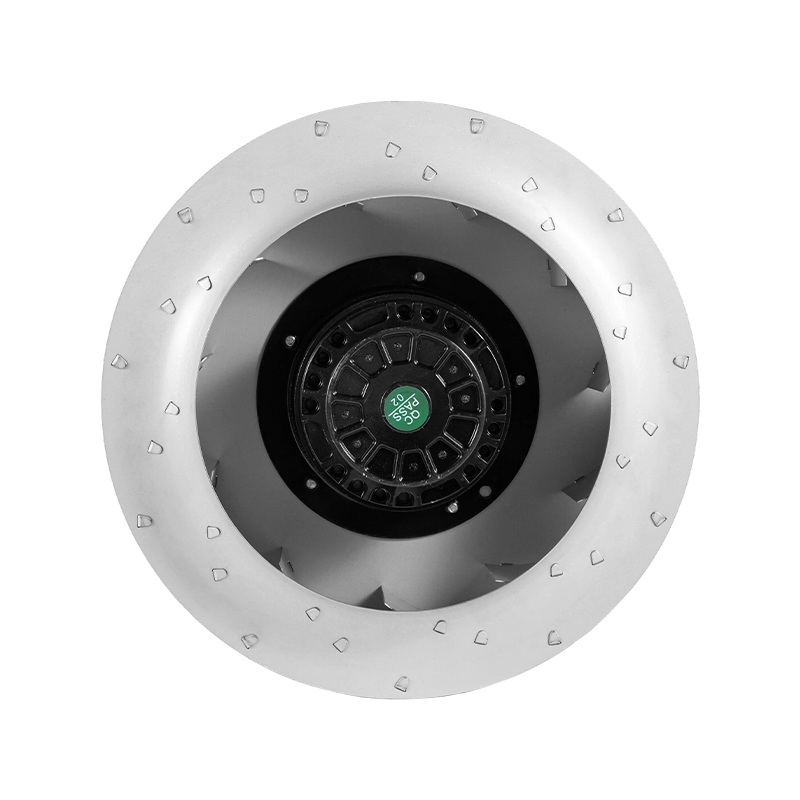 Metal AC Backward-Curved Centrifugal Fan for FFUIndustrial AC fan with a backward-curved impeller for FFU, cleanroom and heat-pump air handling, rated at 4100 m³/h and 1400 W.View Product →
Blade Details That Change Airflow and Pressure
Two impellers can share a blade family and still behave differently. These details matter:
- Diameter and width: larger diameter generally raises pressure; wider wheels move more air but need more shaft power.
- Blade count and angle: more blades can smooth airflow but may add friction and noise; the outlet angle shapes the pressure-flow curve.
- Inlet geometry: a sharp or mismatched inlet ring creates turbulence and robs efficiency.
- Tip clearance and cut-off: small changes at the volute tongue affect noise and pressure.
- Surface and balance: weld spatter, bent blades or missing balance weights create vibration and bearing wear.
Good selection starts with a required duty point, not a catalog size. Ask for the fan curve at the actual voltage and frequency, then compare it with the system resistance curve.
Matching Blade Profile to Motor and Drive
AC, EC and DC fans use the same aerodynamic principles but different control stories. An AC centrifugal fan is simple and robust; speed is set by supply frequency and pole count. An EC fan pairs a brushless motor with integrated electronics, so 0-10V or PWM control can match airflow to demand and support AC upgrade projects. The blade profile should follow the duty, not the drive fashion. A backward-curved wheel on an EC motor can be an efficient replacement for a fixed-speed AC unit, but the impeller and motor must be matched for speed, power and starting torque.
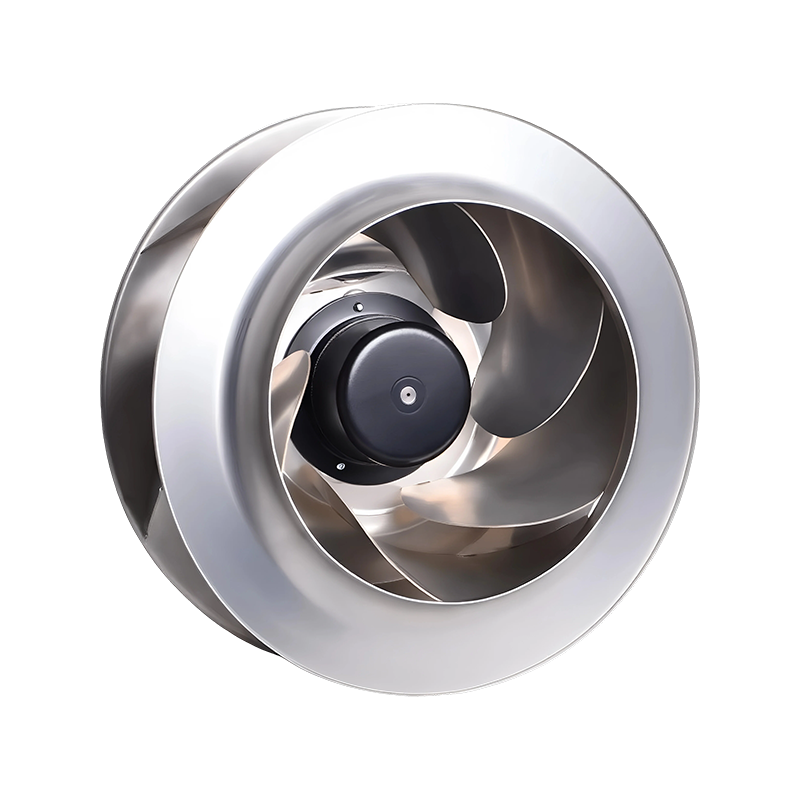 EC Centrifugal Blower for AC Fan UpgradesEnergy-saving EC replacement blower for AC centrifugal fans in data-center cooling and AHU/PAU systems, with 0–10V/PWM control and ErP compliance.View Product →
On the DC side, compact centrifugal blowers with 0-10V or PWM regulation are often used in equipment cooling and air handling where space is tight. The impeller may be smaller, but the same rules apply: avoid over-speed, keep inlet air clean and confirm the fan curve at the actual system resistance.
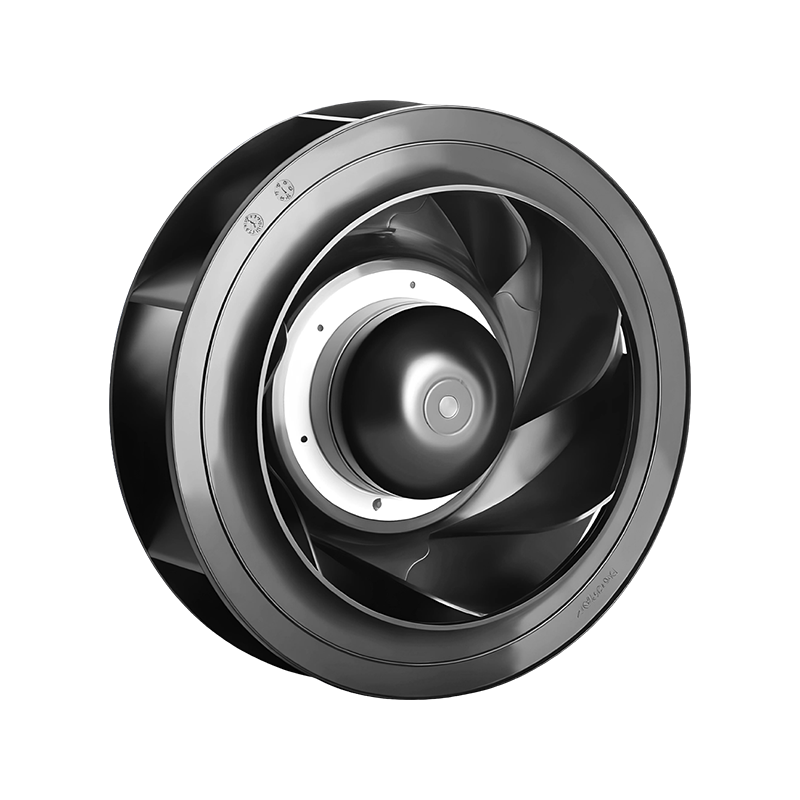 Compact DC Centrifugal Blower with PWM Speed ControlIndustrial compact DC blower with a backward-curved impeller and 0–10V/PWM regulation for medical devices, 3D printers and electronics cooling.View Product →
Materials, Balance and Noise
Most centrifugal fan blades are made from galvanized steel, aluminum or engineering plastic. Steel is durable and suited to higher temperatures; aluminum helps with weight; plastic can reduce cost and corrosion in clean-air products. The manufacturing details matter as much as the material. Blades should be securely joined to the hub and backplate, the wheel should be balanced after assembly, and the coating or plating should suit the environment. Noise usually comes from three places: blade passing frequency, turbulence at the inlet, and vibration from imbalance. A thicker blade is not automatically quieter. Smoother inlet flow and a well-matched volute often do more.
Common Selection and Maintenance Mistakes
- Choosing a fan by diameter alone without checking the duty point.
- Ignoring filter loading and duct resistance at end-of-life conditions.
- Replacing a wheel without matching motor speed, rotation and balance.
- Using a forward-curved impeller in a high-resistance system because it looks compact.
- Letting dust build up on blades; even a thin, uneven layer can disturb balance.
- Forgetting that a VFD or EC controller changes the fan curve with speed.
Vibration, rubbing, a sudden drop in airflow or a hot motor are reasons to stop and inspect. Bent blades, loose fasteners, worn bearings and blocked inlets are common culprits. Our FAQ walks through practical checks if you need a starting point.
Choosing Centrifugal Fan Blades for Your Application
Start with the duty: required airflow, static pressure, ambient temperature, voltage, control method and available space. Then choose the blade family that fits the shape of that duty, and confirm the fan curve at the operating point. For HVAC and ventilation work, our air-conditioning and ventilation application overview shows where these impellers fit. At Beron, we build AC, EC and DC centrifugal fans and BLDC motors, and we test airflow and noise in our own labs. That does not replace a system-level design, but it does help us match a blade, motor and housing that work together instead of merely meeting a catalog number.
NEXT:Axial Fan vs Centrifugal Blower: Choosing the Right Air Mover for Your System
Interested in cooperation or have questions?
-

sale3@beron-motor.com
-
 +86-15906637529
-
 Building 1 (12#), No. 619, Wangmei Road, Linping Street, Yuhang District, Hangzhou, China
 Wholesale Industrial Fan Manufacturers